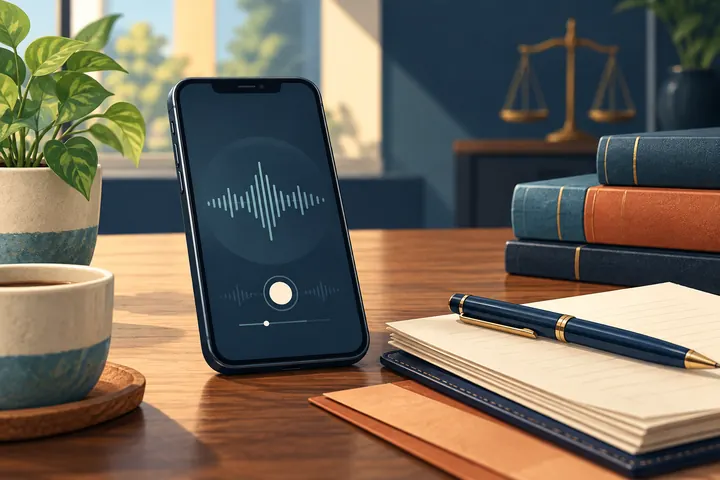
A very common statement in money recovery disputes is:
“He admitted everything during a telephone call. I recorded it.”
A call recording may become important evidence, particularly where the other person acknowledges receiving the money, accepts that repayment is due, confirms the amount, or asks for further time to pay.
But a recording should not be treated as an automatic victory.
What was actually admitted?
There is a considerable difference between someone saying:
“Yes, I borrowed the Rs. 500,000 from you. I need another two months to repay it.”
and simply saying:
“Don’t worry, I’ll sort it out.”
In the first example, the person appears to acknowledge both the transaction and the amount.
In the second, the surrounding conversation becomes much more important. What exactly was being discussed? What was meant by “sort it out”? Was any particular debt identified?
So the important question is not merely:
“Do you have a recording?”
It is:
“What does the recording actually prove?”
Keep the complete recording
If you have a recording that may become relevant to a dispute, preserve the original and complete recording.
Do not cut out only the part where the other person appears to admit the debt. Do not edit different parts together or alter the original file.
The conversation immediately before or after the apparent admission may become important in understanding its true meaning.
Sri Lankan courts have previously considered recorded telephone conversations as evidence, while also recognising issues such as identifying the speakers and properly proving the recording.
“But everyone knows that is his voice.”
That may seem obvious to you, but if the recording is relied upon in a legal proceeding, questions can arise about:
- who was speaking;
- when the conversation took place;
- whether the recording is complete;
- whether it has been altered; and
- how the recording and its contents are proved.
Sri Lankan case law concerning recorded evidence has emphasised matters such as authenticity, safe custody and precautions against alteration or tampering.
This is another reason to preserve the original file rather than relying only on a forwarded copy.
A recording may become stronger when supported by other evidence
Imagine that you have:
- a bank transfer showing Rs. 500,000 paid to the other person;
- WhatsApp messages discussing repayment; and
- a recorded telephone conversation in which that person acknowledges the Rs. 500,000 debt and asks for another month.
Those pieces of evidence may tell a much clearer story when considered together.
A recording does not have to stand alone.
Do not manufacture an “admission”
There is also a practical point worth remembering.
If a dispute has already arisen, avoid trying to manipulate a conversation merely to obtain a particular sentence on record.
A genuine conversation in which a debtor voluntarily acknowledges an existing obligation is one thing. A confusing or deliberately engineered conversation may create further disputes about what was actually meant.
So, is an admission in a call recording useful?
Potentially, yes.
It may become particularly useful where the recording clearly identifies the debt, the amount and the debtor’s acknowledgment of the obligation.
But its value depends on its actual contents, its context, its authenticity and the other available evidence.
Practical point: Keep the original. Keep the whole conversation. And preserve the other evidence surrounding the transaction as well.
Legal references: Karunaratne v. The Queen and the Evidence (Special Provisions) Act, No. 14 of 1995.
General information only. Whether a particular recording can be relied upon in legal proceedings, and the manner in which it must be proved, depends on the facts and circumstances of the individual case. Reading this guide does not by itself create an Attorney-at-Law/client relationship.